Showing posts with label biology. Show all posts

Review: Fascinating Education

Currently I am grading a highschool biology course, I'm doing pretty good on it but sometimes my students ask me a question that requires some research, ergo when I learned about reviewing Fascinating Biology put out by Fascinating Education, I thought, what a perfect opportunity for me to brush up on my highschool biology!! Thank you Fascinating Education for the opportunity to do so.You have been a good help to me.  :)

About Fascinating Education
It was created by Dr. Margulies.  Fascinating Biology, is an online biology course, that comes with 18 lessons.  His goal is to break down the sciences into bite-sized, manageable chunks to increase the learning potential in his students. As you can see, each lesson is broken down into several components.  If you stop your video, it will pick up again where you left off when you return which is ever so handy.  Means you can just stop and not worry about having to start all over again.  Having each section clearly labeled also means you know where he is going as he moves through the lecture.
Each Lesson also comes with a built in glossary/vocabulary section.   If you highlight a word, it's definition shows up below. This is a very handy feature.

How I used it.
One of the things I love about fascinating biology is that I can pick the order I want to do the lessons in.  For instance, one of my students was having a problem with understanding mitosis and meiosis... so I went directly to that section, listened and got the answer.  AND since we get a full course transcript it made it really easy for me to get the answer to my student, and help them find additional support online to help them gain better understanding.  Pretty cool eh?

The 18 lessons are as follows: 
  • What is life
  • Chemistry review
  • The cell membrane
  • Take in Nutrients
  • Take in Energy (four parts)
  • Grow
  • Reproduce (three parts)
  • Homeostasis (two parts)
  • Adapt (two parts)
  • Prokaryotes, Protists, Animals, Fungi
  • Plants
So other than researching areas of concern for my students, how did I actually use it?  
At night!  Seriously, hubby would go to bed, and I'd put in my ear phones and just listen.  I could work on other things, listen and do my brushing up.  It was great!   When an area was harder to understand I could stop what I was doing, rewind the video and listen again while watching the slides.  Then if I really didn't understand I could pull up the transcript and read through it.  Have these two different ways to access the material I felt completely covered! 

I honestly didn't really look at the tests a whole lot but I did take one and much to my surprise I pulled off an 80% which tells me that if you listen AND read the transcripts...you'll nail the material.  The questions come right out of the script.. so honestly listen, read, test yourself if you like to.  BUT as an adult using it as a refresher, seriously its optional.  As a highschool student needing a transcript.. take the test.  :)
If you do take the route of using the tests, as you go through your results you can easily see where you went wrong. Helps with the learning eh?  But seriously, unless you are you taking this for highschool biology credit, don't worry about the tests unless you love taking them.  :)


Taking the Chemistry course first is recommended, but if you choose to do Biology first they have a short chemistry course you can take first. Six lessons to make sure you understand the chemistry part of biology.  It's called Chemistry Pre-course for Biology.  It's a subset of the chemistry course and would be an added cost.

My thoughts:
I love love love how everything is covered in this biology curriculum.. the full course transcript, the ability to watch or listen to the video being taught, the slides, being able to jump around from lesson to lesson learning what I need to.  It's great.  Seriously.  For the purposes for which I am using it, it has been a useful addition into my household. 


Fascinating Education
Fascinating Biology, along with a pre-course (6 lessons that cover the basics of Chemistry bonding methods) to help me brush up on my chemistry.
A full year subscription
Cost $79/yr
Pre-course Chemistry $20
Learn more here.

For the past few weeks I've been reviewing Fascinating Education along with 50 other reviewers.     We've been using these courses:
Fascinating Chemistry
Fascinating Biology
Fascinating Physics

Do check them out, and look over their sample lessons too!
I invite you to click here or on the image below to see what we had to say about them.

http://schoolhousereviewcrew.com/biology-chemistry-physics-fascinating-education-reviews/

You can see my review of Fascinating Chemistry here.


----
This post may contain affiliate links - using affiliate links from A Net in Time helps fuel this blog and our homeschool - thank you! ©2006-2017 A Net In Time. All rights reserved. All text, photographs, artwork, and other content may not be reproduced or transmitted in any form without the written consent of the author. A Net In Time .

Fascinating Fungi

 Affiliate links may be used in this post that help to support us.  Thank you.

One of the things that I like to do when out for a walk, particularly if I have my camera is to stop and take pictures of fungi.

My boys shake their heads at me and keep walking, they simply don't understand why I wouldn't rather take pictures of birds and what not.   But Fungi are cool, they are helpful decomposers of the plant world. 

Most of the fungi I find are this lovely white/beige colour.   Aren't they gorgeous?   Just look at all the variety in them, from rounded shapes, to rosettes or jutting out like mini shelves.   They are fascinating to me.   :)

Imagine my delight when  I spotted this beauty.   It's orange!   Every fungus on the tree was this same shade of orange.   I showed it to my lad when I got home and asked "What do you think makes it that orange colour mom?   I've never seen one like this before."
I have to tell you that I don't know a whole lot about fungi, I just know they are helpful plants that are often overlooked.     They come in a variety of shapes and sizes.   Some...are edible, others will kill you.   Others are so small you wouldn't even know they were there.  

Once when we were camping we learned about a fungus that lives inside of plants and is able to figure out the shortest distance between points.   If you had the time and patience, you could map out a number of landmarks, lay out oatmeal in that pattern and that fungus will figure out the best route for you.   Amazing eh?   They are apparently using that to figure out the best ways to lay down a subway system.   Go figure.

Did you know that fungi are not plants nor are they animals.  They have a classification all their own. They are highly variable in their appearance and action. 

I love how you can find one all by itself, just doing its thing, and at other times you see so many of them, you can hardly see the wood it's growing on.    Such variety in what seems an insignificant organism.  They just delight me.

So I heard that Educents was going to have a sale and they sent me a reminder that I have a credit with them and that perhaps I might want to use it up.   This made me wonder... might they have information about fungi?

And look.. THEY DO!!!


They have this bacteria and fungi kit. Young Scientists of all ages will be fascinated by growing bacteria and fungi of all colors and textures in Petridishes. They will discover how antibiotics cure disease. Students finish the kit by “waking”the common fungus called yeast.


Or check out this product: Germs and Fungus Lessons and Experiments.  Learn how to prevent the spread of germs.  Describe the various shapes of fungi and more. 
Oh Ick.  Gives students a chance to do science, including observing fungi growing as they make a mold zoo.   Not only that, there are 114 science experiments to be found at your fingertips, so even if you aren't fascinated by fungi, you are bound to find something that intrigues you.  :)


Just think of the fun one could have working with fungi, growing it, examining, watching it and most importantly...learning about it.   And Educents will give you a discount to do so.  Cool eh?

If you are  first time member did you know you get a discount on your first order?   You can find out the details for that RIGHT HERE

For all other discount options, see the image below.

Snakes

yesterday was Easter. WE have a tradition in our house whereby I find some small toys and some candies and put them in eggs and hide them about the house. 

This year I found some snakes (three of them) and put them into eggs. One Six year old was thoroughly delighted. 

This of course has led to tons of questions about snakes. He's learned about milking poisonous snakes.
 

He has asked how long it takes for snakes to replenished their venom. And discovered that it takes up to 24 hours for it to be replenished for most snakes, but some snakes it can take longer. 

He's learned how green snakes camouflage themselves in .. green grass. :) And how other snakes can do the same thing.

Currently working on...ecosystems

Building a study on ecosystems.

NOT a particularly easy thing to do as ecosystems can be as generic as "oceans" or as specific to "this puddle of water". Since the lad is six, I won't be doing EVERYTHING that there is to learn. But I will give him a good overview and hopefully start it as a small binder so that over the years we can add to it.

I think I'll concentrate on Forests, Water (salt and fresh), Tundra and icecaps, Deserts, and Grasslands.

I'll be pulling in information from a variety of sources.
Pronto Lessons on the ecosystem will be a starting point.

Then I'll pull in information from national geographic, Canadian forest services, Geography4Kids, KidsGeo.com, KidsCorner, neoK12, and ecosystems.

time to homeschool.
will do more planning later. :)

question of the day: praying mantis

this is not the one we caught, just a pic off the internet.

Due to a caught praying mantis, and wondering if we could keep it, this question was raised: What do praying mantis eat?

We found an answer here.

The diet of a praying mantis most often includes various species of insects - including mosquitoes, flies, grasshoppers, beetles, butterflies, moths, spiders, roaches, bees, dragonflies, etc. Other than these insects, some praying mantis species also feed on lizards, frogs, rodents and birds. Almost all the species of mantis feed on insects, but those which can grow up to a length of 10-12 cm are generally the ones who take on birds, rodents and other creatures of their own size.
So, no, we can't keep it as it will eat our crickets. We released it to our rose of sharon bush.

How can you tell a girl from a boy?

The difference between a male and female praying mantis is that the female is larger and the abdominal is larger than a males abdomanal.
Adult female Mantises are larger than adult males. That's one way to tell them apart.

Monarch into Chrysallis

Check out this youtube video.

Both monarchs that we have are going exploring. The one is currently hanging, the other is looking for a place to be safe. We're having to keep a close eye on that one.

Hopefully in seven to 10 days we'll have a couple of butterflies to watch! :)

our previous attempts at Monarchs failed, so we're thrilled that this one appears to be working.


Toads


Toads are the subject of fascination for a boy child lately.

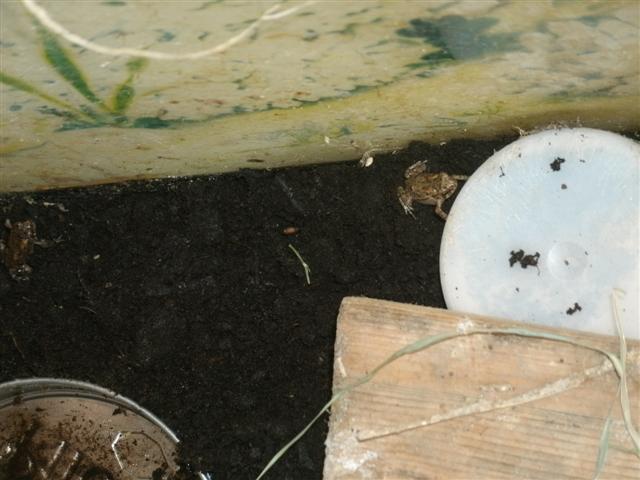
We went to the Pinery yesterday for lunch and a bit of a walk about. At lunch we sat near a pit in the ground. It had several young toads in it. the lad caught six in total. one escaped due to my ineptitude. Two were released for being too big.

The remaining three were put into a larger bottle and carried with us on our walk.


Somehow on out trip home the bottle got on a tilt or lay flat and two of the three escaped. We recaptured one of them.

Those two discovered the "joys" of a new home. :)

hard at work setting things up


The end result.


One relatively content toad.


Tonight they were joined by one much bigger toad captured on a "toad" walk with gramma. Tomorrow morning the lad will totally reorganize the aquarium, but as long the toads are healthy it's all good. Boys are meant to play with small critters aren't they?

These tears I hate: Tears when a boy learns something in a very hard way.

Since these toads are tiny I put a little apple cider vinegar in a container to attract fruit flies. The flies came, the little toads were happy. The lad thought GREAT! I'll dip the toad in the vinegar to help bring flies right to the toad. We then all learned that toads plus apple cider vinegar equals a very quickly dead toad (so dead his tongue came out). Many tears from my soft-hearted son. Much sadness from his mommy at this hard lesson to learn...hard for all. We don't want to kill the toads...we want to learn from them and see what works to keep them healthy and happy.

question of the day: how long do yellow jacket's live?

We have a yellow jacket living in our house. He buzzed us while doing the dishes.
He got away.

My lad who is somewhat concerned about getting stung asked "how long do yellow jacket's live?" I said.. I have no clue, shall we look it up?

We learned that MOST of them only live for the summer BUT the queen hibernates over the winter and she is the one who chooses where the next years colony will live.

Source: backyard Brigade and other internet sources that confirmed what Backyard said. :)

Finally... we know what it is :)


My thanks to homeschool freebie of the day for linking to this site! we were finally able to identify the caterpillars that keep dying on us!

unlike the sycamore and hickory tussock moths, this one is the pale tussock moth. and these guys eat oak, birch, lime and hop leaves.

Other sites they linked to today were BugGuide and What's that Bug.

Octopus camouflage


this is simply too cool.

The lad's end comment "so camoflage is just fooling what's looking at you?"

caterpillars

The lad has a thing for caterpillars lately. :)

we've found three SYCAMORE TUSSOCK MOTH. They died on us. We need to figure out what they eat so they don't die next time.

they apparently eat the leaves of sycamore trees. interesting. But we put leaves in with them from where we found them. I guess I need to learn how to identify a sycamore tree. :)

we've also had these for a short time. HICKORY TUSSOCK MOTH. They escaped though. :)

Found the caterpillars at this site.

Monarch butterflies


this is Chris.

he is a monarch butterfly.

we found his egg while camping.

He seems like a nice 'lad' (not that I know if he is a lad or not, but the lad we have is enjoying watching him grow).

We've successfully hatched out into adult stage a white Moth in the past, so we're hoping to be successful with Chris the monarch as well.

This site is helpful in teaching more about monarchs.

We're finding it an interesting experience. We lost one monarch egg to ants, we lost another when we changed out the leaves (they didn't transition well), so we're hopeful that this time will be more successful. Time will indeed tell.

That lad is VERY much into capturing caterpillars lately and seeing if we can get them to change into moths and butterflies lately.

His latest capture was a fuzzy red caterpillar that poops/pees and runs VERY fast when you attempt to catch him. It's was quite the achievement for the lad to catch him. We've never had another caterpillar do that so it was quite the learning experience.

Some caterpillars we've learned don't handle capture well so we don't catch them. Some will just up and die. Others within a day or two will pupate. Others just wander and seem to do well in captivity. It's been educational to say the least.